
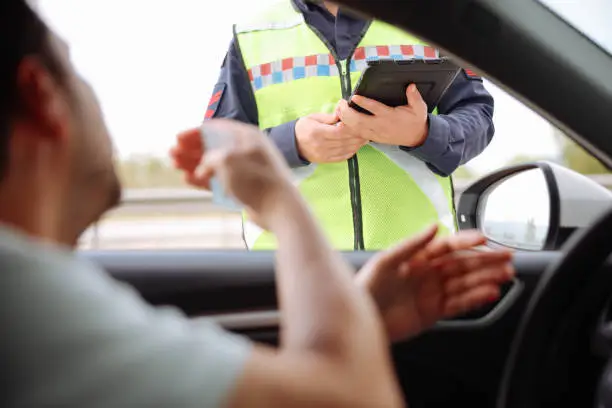
Between 10 and 16 August 2026, Spain’s Guardia Civil checked 3,855 vehicles on the roads of the Balearic Islands. Nearly 200 drivers tested positive for alcohol or drugs and 9 police reports were opened for road traffic offences, according to the Guardia Civil statement reported by La Voz de Ibiza. If your positive test came in a rental car in Ibiza, the first hours matter more than they seem.
A positive test is not a conviction. Depending on the reading, the matter is dealt with as an administrative fine or as a criminal offence, and what you sign, say and accept in those first hours shapes the outcome. The figures come from Spain’s national traffic authority and the Criminal Code, and were reviewed on 13 October 2026.
Quick summary
|
What happens when you test positive at a drink driving check
The officer asks you to blow into a breathalyser. If the result is over the limit, or the officer sees signs of intoxication, the test must be repeated after at least 10 minutes. Both results go into the test record. That record is the basis of everything that follows, which is why you should read it before signing.
You have the right to check the result with a blood or urine test. You pay for it up front and are reimbursed if the result is negative. Breathalysers also have a margin of error. In judgment 788/2023, the Spanish Supreme Court applied a 7.5% margin: with a reading of 0.65 mg/l, the effective level came down to 0.60 mg/l and there was no offence. A reading close to the threshold deserves a technical review.
If you refuse to blow, the refusal becomes an offence in its own right. Refusing the test can turn out worse than testing positive, because article 383 of the Criminal Code provides for 6 months to 1 year in prison and a driving ban of 1 to 4 years, whatever the result would have been.
Fine or criminal offence: the consequences at each level
The reading decides the route. Below the criminal threshold, the positive test is handled as an administrative offence before the traffic authority. Above it, it is handled as a road traffic offence before the court. A standard driver cannot exceed 0.25 mg/l in exhaled air. For professional drivers and novice drivers, with less than two years of licence, the limit drops to 0.15 mg/l. You can see the full breakdown in our article on when drink driving is a fine and when it is a crime.
| Result | Route | Consequence |
| Up to 0.25 mg/l (standard driver) | Within the limit | No penalty for the reading. Novice and professional drivers: limit of 0.15 mg/l |
| 0.25 to 0.50 mg/l | Administrative offence | €500 fine and 4 points |
| 0.50 to 0.60 mg/l | Administrative offence | €1,000 fine and 6 points |
| More than 0.60 mg/l (or 1.2 g/l in blood) | Criminal offence, article 379.2 of the Criminal Code | 3 to 6 months in prison, or a fine spread over 6 to 12 months, or community service of 31 to 90 days, and a driving ban of 1 to 4 years |
| Any reading with proven impairment of driving | Criminal offence, article 379.2 of the Criminal Code | Same penalty range as the row above |
| Refusing the test | Criminal offence, article 383 of the Criminal Code | 6 months to 1 year in prison and a driving ban of 1 to 4 years |
The figures for fines, points and sentences come from the traffic authority’s guidance on alcohol and drugs and from the Criminal Code. The reform that aimed to lower the general limit to 0.1 mg/l has not gone ahead: the Interior Committee rejected it in March 2026 and the 0.25 mg/l limit remains in force.
What to do step by step in the first hours
These are the decisions that most affect the outcome, in the order they come up:
- Cooperate with the identity check and the first test. Refusing to blow makes your situation worse.
- Ask for the second test and, if you want to check the result, a blood test.
- Read the test record before signing. If you do not understand the language, ask for an interpreter. Note the time of each test.
- Ask for a lawyer before making a statement. If you are arrested, you have the right to a lawyer and an interpreter, and to have your consulate told of your arrest.
- Tell the rental company. Better that they hear it from you than from the tow truck.
- Keep all the paperwork: the test record, the test results, the court summons and the rental agreement.
- Do not book another flight without speaking to your lawyer. A court summons can coincide with your departure date.
If you are arrested, the detention cannot last more than 72 hours (article 17.2 of the Spanish Constitution). The police report goes to the duty court, and the decision on your freedom, your summons and how the case proceeds is taken there. We have explained that journey in our guide from the police station to the duty court in Ibiza.
What happens with the rental car
If you test positive, traffic rules allow the vehicle to be immobilised unless another authorised driver in a fit state can drive it. Towing and pound costs are charged to the driver. If the rental company hears about it from you, that is much better than if it finds out from the tow truck.
The rental agreement is the second front. Rental conditions generally prohibit driving under the influence of alcohol or drugs and treat it as a serious breach. Optional cover does not pay for these costs, and the hirer is liable for damage, fines, towing and the pound, plus a €25 administration fee for each fine the company processes. Other companies may have similar clauses, so read the contract you signed before disputing anything.
Insurance works the same way in practice. When a third party suffers damage, the insurer usually pays and then claims the money back from the driver who was driving under the influence. An accident with a positive test can turn a covered claim into a personal debt.
Speedy trial and your flight: how the court, the car and your trip fit together
Drink driving offences are usually handled through the speedy trial procedure. After the police report, the duty court summons the suspect and can hold the trial within hours or a few days. In the Balearic Islands, these cases are decided by the duty courts of Palma, Inca, Manacor, Ibiza and Mahon.
In a speedy trial you can accept a plea agreement: you admit the facts and the judge passes sentence with a one-third reduction of the penalty. It has its requirements and its consequences. A guilty verdict creates a criminal record and the driving ban applies all the same. Deciding without knowing what the test record says or what technical margin the breathalyser has is the most common mistake among people who arrive without a lawyer.
| Moment | Court | Rental car | Your trip |
| At the roadside check | No court involvement yet | May be immobilised if no authorised driver can take over | You are summoned or taken in. Note the time of the tests |
| First hours | The police report goes to the duty court | Tell the rental company | Do not book another flight without advice |
| Up to 72 hours | Maximum period of detention | Towing and pound costs are yours | Ask for an interpreter and tell your consulate |
| Following days | Speedy trial or later summons | The company claims damages, fines and handling fees | Your lawyer can handle the court appearance |
Can I leave Spain while the case is under way?
There is no automatic rule. It depends on the judge and the circumstances of the case. In a positive test with no victims, a summons may be enough, although the judge can impose precautionary measures. In serious cases the judge does. In July 2026, in a case involving a fatality in Mallorca, a judge withdrew the driver’s passport and banned him from leaving the country.
That is why, before you buy a ticket or fly, you should ask your lawyer what the court has told you and whether you can appear through a representative. If you leave without answering a summons, you can make your situation worse.
Your foreign driving licence and your home country
The driving ban applies in Spain: while it lasts, you cannot drive here, even if your licence is from the EU, the UK or another country. The Spanish Supreme Court treats foreign licences as subject to Spanish rules when driving in Spain, and driving while banned is a separate offence under article 384 of the Criminal Code.
What happens in your own country depends on its rules. The Court of Justice of the EU, in case C-260/13, accepts that a State may refuse to recognise in its territory a licence issued by another State after an offence committed there. Check with an adviser in your home country how a conviction obtained in Spain is treated.
If you are a temporary resident or a tourist: on-the-spot fines and deposits
If the offence is administrative and you cannot show residence in Spain, the officer can set the fine on the spot. If you do not pay a deposit, the vehicle can be immobilised. The rule is in article 87.5 of Royal Legislative Decree 6/2015, the Road Traffic Act. Keep the receipt and always ask for a copy of the fine notice, because you can appeal it later even if you have paid.
Common mistakes tourists make after a positive test
- Signing without understanding the test record. Ask for a translation and do not sign until you know what you are admitting.
- Refusing to blow to avoid the result. It is an offence with a heavier penalty than many positive tests.
- Making a statement without a lawyer to get it over with. What you say at the police station is used at trial.
- Not telling the rental company and letting it find out from the tow truck or the police report.
- Leaving Spain without knowing whether there is a summons, or accepting a plea agreement without knowing it creates a criminal record.
The criminal record from a drink driving conviction can be cancelled once the periods set by article 136 of the Criminal Code have passed. Until then it can affect residence, work or travel procedures.
When to hire a lawyer in Ibiza
Once the reading goes above the criminal threshold, or if there is an accident, injuries or a refusal to take the test, you should have a lawyer from the first moment. At Forte Abogados, our road traffic offences lawyers in Ibiza review the test record, the way the test was carried out, the calibration of the breathalyser and the deadlines before deciding whether to defend the case at trial or accept a plea agreement. That decision must be made with the file in front of you.
Our defence in drink driving cases comes with direct attention from the lawyer, with no intermediaries. We also assist clients who do not speak Spanish: we explain what you are signing, what you are being asked and what real options you have, with an honest assessment of your case. This is the work we do within our Criminal Law in Ibiza practice area.
Frequently asked questions about a positive breath test in a rental car
What happens if I test positive for alcohol as a tourist in Spain?
The same law applies as to a resident. If the reading is between 0.25 and 0.60 mg/l, it is an administrative offence with a fine and points. Above 0.60 mg/l it is a criminal offence and the police report goes to the duty court.
Can I be arrested for a positive test in a rental car?
If the reading is above the criminal threshold, the police open a criminal case and can arrest you and bring you before the court. Detention cannot exceed 72 hours. Below the criminal threshold, the positive test is handled as an administrative offence.
Does rental car insurance cover an accident involving alcohol?
Normally it does not cover your own costs, and contracts usually expressly exclude driving under the influence of alcohol. The insurer may pay the injured third party and then claim the money back from you. Check the conditions of your contract.
Can I ask for a second test or a blood test?
Yes. If the first result is over the limit, the test must be repeated after at least 10 minutes. You can also ask for a blood or urine test to check the result. You pay up front and are reimbursed if it comes back negative.
Can I go back to my country while the case is under way?
It depends on the judge and the measures imposed. In a positive test with no accident, a summons may be enough, although there is no automatic rule. Speak to your lawyer before leaving Spain so you do not miss any court appearance.
Should I accept a plea agreement in a speedy trial?
A plea agreement reduces the sentence by a third, but it means admitting the facts and creates a criminal record. Consider it only once a lawyer has reviewed the test record, the breathalyser and the procedure.
Will my foreign driving licence be taken away?
If you are convicted, you are banned from driving in Spain for 1 to 4 years. The effects in your home country depend on its rules. Check how your country treats a conviction handed down in Spain.
Will I have a criminal record?
A conviction for a drink driving offence creates a criminal record. It can be cancelled once the periods in article 136 of the Criminal Code have passed. An administrative offence does not create a criminal record.
This article is for information only and does not replace a lawyer’s advice on your specific case. The rules and case law cited were reviewed on 13 October 2026.